
Peer Exchange: Managing Strategic Compensation in Today’s Environment
WCD Compensation & Human Capital Committee Peer Exchange
Summary
On March 9, 2026, Women Corporate Directors (WCD), in collaboration with Pearl Meyer, convened virtually for the Compensation & Human Capital Committee Peer Exchange for a discussion on Managing Strategic Compensation in Today’s Environment. The panel was moderated by Jannice Koors, Senior Managing Director, Pearl Meyer, and included Jane Okun Bomba, President, Saddle Ridge Consulting, LLC; Director, Clarivate Plc., BrightView Holdings; WCD Greater Colorado; Susan Chapman-Hughes, Director, Toast, Inc., The J. M. Smucker Company; WCD New York; and Kimberly Neil, Principal, Pearl Meyer.
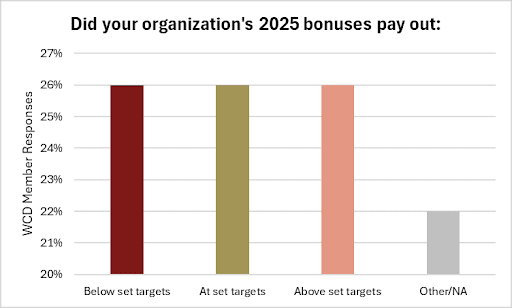
In polling conducted leading up to the Peer Exchange, WCD members were asked to share how their companies’ 2025 bonuses paid out. As shown in the chart below, expected 2025 incentive payouts are evenly divided between below, at, and above set targets. The 2025 results had a varied impact on 2026 goal-setting, with some companies adjusting goals to be easier or harder based on performance, and others treating them separately.
The panel conversation focused on how companies are addressing the continued level of uncertainty in being able to plan for incentive design as well as the differences between when to decide whether to “tweak” an existing plan or “throw out plans and start over.” Below are the key themes from the discussion.
Short-Term vs. Long-Term Incentives
Panelists discussed the differences between short-term and long-term incentive structures. Annual cash bonuses are typically tied to Wall Street guidance or internal budgets, while long-term incentives (LTIs) may consist of multi-year Performance Share Units (PSUs) or a combination of stock options and time-vested Restricted Stock Units (RSUs). Among these structures, PSUs were identified as particularly difficult to forecast due to the challenge of predicting company and market performance over a multi-year horizon. Throughout the conversation, differences in how specific industries approach incentive compensation reinforced that there is no one-size fits all approach for setting incentives. For example, it was noted that in the tech industry, “the annual incentive plan is a very small part of compensation, with the majority traditionally coming through LTIs, whereas the approach in more established or other industries may be a bit more balanced.”
The Role of Discretion and Plan Adjustments
The panel also examined how boards think about situations where formulaic incentive payouts produce outcomes that are not aligned with business performance. Panelists agreed that compensation committees should conduct robust scenario analysis and be prepared to defend their decisions, particularly in situations where company performance is strong but external market conditions are unfavorable. As one panelist explained, decision-makers must “run the scenarios, including the ‘what-if’ situations, and then make the call,” drawing on their understanding of the business and knowing they can defend the decision. Many participants agreed that there is a preference against using discretion, and that when it is used, it should be done within the parameters of predetermined criteria—such as major regulatory changes, legal issues, or natural disasters—and typically be capped at 10%.
To improve alignment between incentives and outcomes, companies are increasingly adjusting plan design upfront. One speaker noted that companies are widening “strike ranges, so that if performance falls within 1-2% of the target, it is still considered target performance and gives a little grace to that achievement level.” Additionally, incorporating qualitative factors can help align performance with strategic long-term goals. However, she acknowledged the difficulty of separating incentive targets from the budgeting process, even though doing so can improve the effectiveness and credibility of performance targets.
Payout Curves and Goal Setting
Typical payout curves discussed by the panel included a threshold payout at 50% of target performance and a maximum payout at 200%. Panelists emphasized the importance of setting rigorous and well-calibrated goals that align with these payout levels, often using external market data to provide context. They also stressed that goal setting should not be driven solely by financial metrics. Instead, targets should reflect broader company objectives and key qualitative milestones.
Triggers for Major Plan Overhauls
When considering whether an incentive plan may require a significant overhaul rather than incremental adjustments, panelists flagged three warning signs:
- Consistent under- or over-performance: This may indicate misaligned goal setting. If employees frequently receive maximum payouts or repeatedly receive no payout, it may suggest that targets are not calibrated appropriately. As one panelist noted, “Overperformance is not something you want to see over and over because it probably means you’re not setting plans appropriately, unless the business is killing it.”
- Excessive use of discretion/adjustments: Excessive reliance on discretion or adjustments can signal structural issues within the plan. As one panelist said, “At what point do you say, ‘We’ve now exercised meaningful discretion three years in a row. At some point, it stops being extraordinary when it happens every year and you just need to make a change.’”
- Company changes: Significant changes within the company itself, such as rapid growth, going public, shifts in peer groups, or changes in the company’s stage of maturity, can necessitate a redesign of incentive programs. A plan overhaul is not always a sign that something is broken; “sometimes the nature of the business is evolving and you need to adjust your plan to accommodate that.”
The Importance of Communication
Panelists stressed the importance of transparency, early engagement, and consistent messaging so that executives understand the company’s compensation philosophy and the rationale behind any changes. As one panelist shared, organizations must ensure that leaders understand “what your compensation philosophy is and why changes may or may not happen,” underscoring the importance of consistency. “Change happens at the speed of trust. If we don’t have everyone on board and we haven’t appropriately communicated goals and objectives, we’re not going to get the results we want.”
Breakout Room Conversations
In smaller group sessions, members touched on several additional topics including:
- Shareholder Alignment and Dividends: Members acknowledged the balance needed in situations in which companies may owe executives large bonuses but the company has decreased or suspended dividends. The group agreed that such situations require careful use of discretion. In many cases, capping bonuses at target levels may be appropriate to avoid shareholder backlash and negative scrutiny, including potentially getting the attention of activist investors.
- Private Company Differences: Clear communication is particularly critical in private or family-owned companies where performance-based compensation may represent a cultural shift. Without transparency around goal setting and performance expectations, incentive plans may fail to motivate behavior. A participant noted that in private companies, where public disclosure requirements are less stringent, it becomes even more important to establish transparent processes around goal setting and target determination.
- Peer Group Comparisons: Some attendees were curious how and when other boards use peer group comparisons. One member shared that her company looks at each component of executive compensation against the peer group to set the actual incentives. However, the targets are set against internal measures, using strategic long-range planning and budgets.
Conclusion
In closing, panelists acknowledged the ongoing challenge of designing effective incentive plans in a macroeconomic environment defined by uncertainty. Companies must continually balance their need to attract and retain talent with their fiduciary responsibility to shareholders. As one
participant summarized, “What’s really clear is how much we’re all struggling with the uncertainty in the macro environment and how we tailor our plans to attract and retain the talent we need while still being responsible fiduciaries.”
Importantly, companies do not necessarily need to wait for a crisis before making adjustments. Incentive programs should evolve alongside business strategy, with both remaining in close alignment. Ultimately, the panel agreed that the most important objective is maintaining alignment between stakeholder value and incentive design—not just at a single point in time, but over the long term. “The work of a compensation committee is certainly easier in an environment where there’s a process for strategic long-term planning and the board is having regular conversations with executives about a long-range plan and how external factors affect that.”